
At the national level, the RICREA Consortium is tasked with the management of steel packaging waste. It aims at maximising the environmental benefits generated by the recycling of steel packaging, intervening through “direct management” (or consortium management) of the material (through Agreements or other specific arrangements for the recovery of packaging only), or via “indirect management” (through agreements to recognise the share of steel packaging in the ferrous material sent for recovery). All data is traced according to procedures validated by the CONAI system, and the results are counted as national recycling performances.
Taking stock of 25 years
of the RICREA consortium
RICREA's contribution to the fight against climate change
The environmental benefits of the circularity of steel packaging
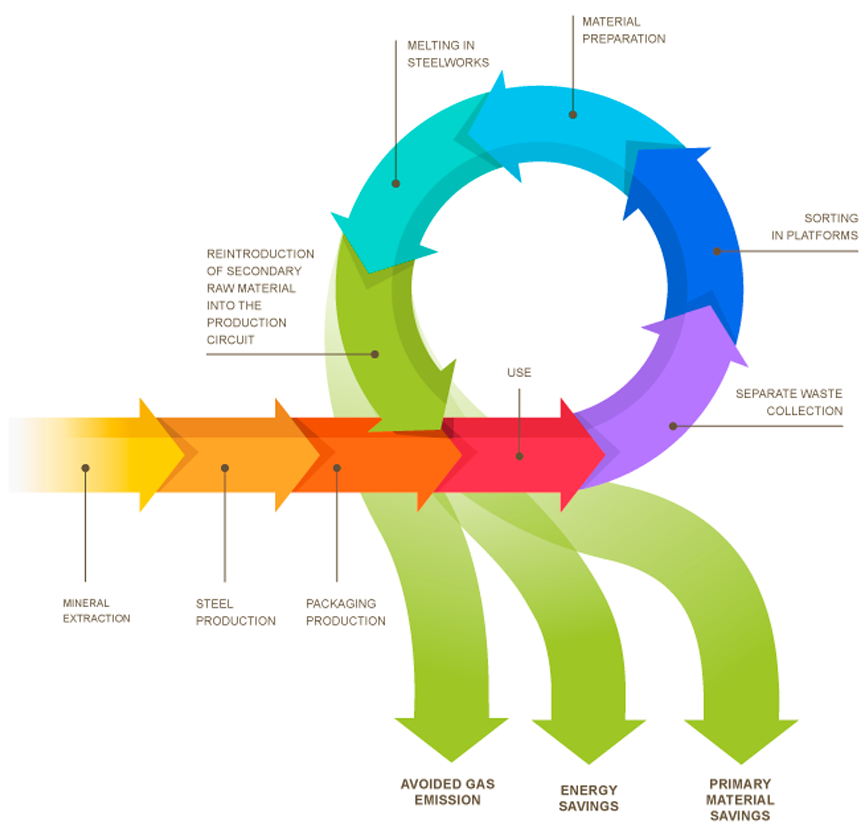
Avoided greenhouse gas emissions
By preventing materials from going to landfills and promoting the processing and use of secondary raw materials instead of virgin ones, the recycling sector enables lower energy consumption and consequently fewer emissions of climate-altering gases into the atmosphere, providing a significant contribution to the fight against climate change. The recycling of steel packaging waste and the regeneration of drums and cisterns nationwide has collectively avoided the emission of 14 million tons of greenhouse gases (CO2eq) into the atmosphere over the 25 years between 2000 and 2024. The “direct management” of material by the RICREA consortium system is responsible for 57% of this environmental benefit (8.1 million tons of CO₂eq avoided). If we look at the values of avoided emissions year by year, the trend is clearly growing, and in 2024 a record of 868 thousand tCO2eq avoided was reached, more than four times that of 2000.
Avoided Emissions from Steel Packaging Waste Recycling in Italy, 2000-2024 (ktCO₂eq)
Source: CONAI

Note: the indicators for the years 2000 to 2024 were estimated based on supply chain flows, identifying the best available data to represent the technologies and processes in use during the reference period.

Energy savings
All the activities which, starting from the collection of waste, lead to the re-marketing of the secondary raw material, are less energy-intensive and have a lower impact than the activities necessary to make an equivalent quantity of primary raw material available. In Italy, between 2000 and 2024, the recycling and regeneration activities of steel packaging waste have avoided the national consumption of approximately 59 billion kWh of primary energy. Of this, 58% is attributable to RICREA’s “direct management” alone (33.8 billion kWh).
Primary Energy Saved from Steel Packaging Waste Recycling in Italy, 2000-2024 (GWh)
Source: CONAI

Note: the indicators for the years 2000 to 2024 were estimated based on supply chain flows, identifying the best available data to represent the technologies and processes in use during the reference period.

Primary material savings
Recycling packaging waste allows for the use of secondary raw materials, thereby avoiding the consumption of virgin raw materials and, consequently, primary materials. Between 2000 and 2024, at a national level, the recycling of steel packaging waste from sorted and unsorted public collection, along with the regeneration of drums and IBCs from private sources, has resulted in avoiding the consumption of 10 million tons of primary material. Of this, 59% is attributable solely to RICREA’s “direct management.” In 2024, the highest value of raw material saved was recorded, at 495 kilotons.
Raw material saved from recycled steel packaging waste in italy, 2000-2024 (KT)
Source: CONAI

Note: The indicators for the years 2000 to 2024 were estimated based on supply chain flows, identifying the best available data to represent the technologies and processes in use during the reference period.

The economic benefits of recycling
In addition to the reduction of environmental impacts, the recovery of steel packaging generates direct economic benefits for the country (connected with the reduction of expenditure for the importation of raw materials) and indirect benefits (measurable as monetisation of the benefit deriving from avoided greenhouse gas emissions). Overall, it’s estimated that between 2000 and 2024, the management of steel packaging waste generated economic benefits totaling €1.4 billion from recovered materials and €538 million from avoided CO2 emissions. In 2024 alone, the total economic benefit was €162 million (€110 million from recovered materials through recycling and €52 million from avoided CO2).
Economic Benefits of Steel Packaging Waste Recycling in Italy, 2000-2024 (Millions of Euros)
Source: CONAI

Note: the indicators for the years 2000 to 2024 were estimated based on supply chain flows, identifying the best available data to represent the technologies and processes in use during the reference period.

IL CONSORZIO
PARTNERS
RICREA EDU